

Dust might seem negligible, but for communities near new road construction, quarries, demolition sites, and other industrial activities, it silently affects health, amenity, and both flora and fauna. Today’s dust management tools including dust sampling bottles and directional devices like the DustScan bring clarity to this vague parameter, helping engineers, regulators, and public understand and control generation of dust particles more effectively.
Dust sampling bottles capture deposited dust over a set period typically one month. The gravimetric and chemical analysis helps in determining the deposition rates and potential environmental or nuisance impacts. Though less precise in tracing airborne sources, they remain reliable baselines and regulatory tools for monitoring settled dust. Picture 1 shows the dust sampling bottle employed at a sampling site.
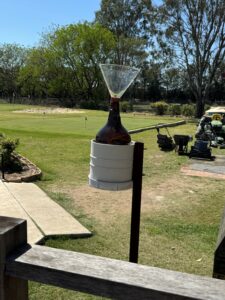
Picture 1: Depositional Dust sampling
While dust bottles effectively measure deposition rates, they don’t indicate the origin of the dust. This shortcoming is overcome by devices like the DustScan. It uses directional sticky‑pad sampling to pinpoint the source direction. DustScan uses roughly 2 metre‑tall sticky cylinders aligned to north and capture air‑borne dust from all directions as shown in Picture 2. Dust sticks on to the pad and is scanned to calculate two key metrics:
- Absolute area coverage (AAC%) – the total portion of the pad dusted.
- Effective area coverage (EAC%) – the optical darkness indicating soiling potential.
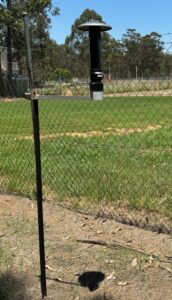
Picture 2: Directional dust sampling
These samples are captured over a shorter interval (7–14 days), and identify dust nuisance hotspots and patterns by direction.
Real-World Application
- Fence-line Monitoring: DustScans placed at site perimeters show whether and from which direction wind-blown dust is entering sensitive receptors, such as residences or natural areas.
- Source Apportionment: In practice, DustScan data combined with chemical analysis (such as heavy metals) helps in determining whether dust originates from background sources like farming or from quarry activity.
- Empowerment Through Understanding: Residents gain trust and become aware of opportunities, such as when to schedule construction or dust suppression to reduce risk, when they realise that increases in dust deposition correspond to dry, windy days.
- Preventing Conflict: DustScan assists in validating or dispelling community concerns by clearly displaying the time and location of dust origins.
Is dust management an issue?
At Trinity Consultants Australia, we are the sole provider of DustScan equipment across the country. With extensive experience in air-quality management, our team specialises in the expert installation, alignment, and ongoing maintenance of the DustScan directional dust monitoring system. We supply and support the full equipment suite sampling cylinders, sticky pads, and secure stands—tailoring sampling intervals (weekly or fortnightly) to your site’s activity and reporting requirements. Once collected, our engineers employ advanced DustScan software to scan and convert each sample into precise metrics—Absolute Area Coverage (AAC%) and Effective Area Coverage (EAC%) while directional pad patterns reveal the wind-blown origin of dust.
From installation to data interpretation, this comprehensive service provides precise, useful insights to assist proactive dust-control measures and regulatory compliance. For further information, please contact our Brisbane team via our contact form or refer to our service page: Directional dust monitoring